Note
Go to the end to download the full example code.
Anatomy of the pipeline#
OCRPipeline is four swappable stages:
detector → post-processor → crop_quads → recognizer → decoder
This example runs them one by one, so each can be inspected or replaced.
from pathlib import Path

import matplotlib.pyplot as plt
import torch

from torchocr import CTCGreedyDecoder, DBPostProcessor, load_charset
from torchocr.decoders import build_decoder
from torchocr.io import load_image
from torchocr.models import CRNN, DBNet, CRNN_ResNet34_VD_Weights, DBNet_ResNet18_VD_Weights
from torchocr.ops import crop_quads

ASSETS = Path("../examples")  # run from the gallery/ directory, as sphinx-gallery does
image = load_image(ASSETS / "english_doc.jpg")
1. Detection#
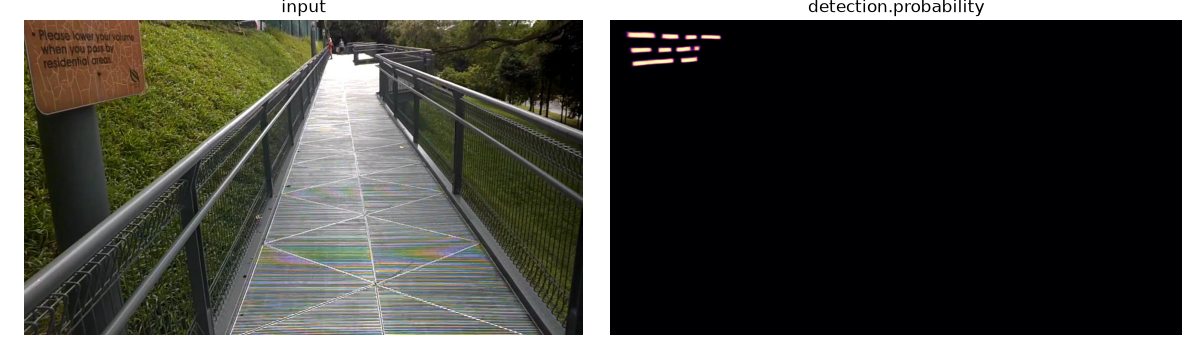
The detector predicts a per-pixel text probability map. Its weights entry provides the preprocessing it was trained with (resize to multiples of 32, normalization).
det_weights = DBNet_ResNet18_VD_Weights.ICDAR2015
detector = DBNet(weights=det_weights).eval()
detector_input = det_weights.transforms()(image)[None]
with torch.inference_mode():
    detection = detector(detector_input)  # DBNetOutput(probability, threshold)

fig, (left, right) = plt.subplots(1, 2, figsize=(12, 3.5))
left.imshow(image.permute(1, 2, 0))
right.imshow(detection.probability[0, 0], cmap="magma")
for ax, title in ((left, "input"), (right, "detection.probability")):
    ax.set_title(title)
    ax.set_axis_off()
plt.tight_layout()
2. Post-processing#
DBPostProcessor turns the probability map into rotated quadrilaterals, sorted
in reading order (torchocr.ops.reading_order()).
They are in the resized image’s pixels; scale them back to the original.
postprocess = DBPostProcessor(**det_weights.meta["postprocess"])
quads = postprocess.quadrilaterals(detection)[0]
scale = torch.tensor([image.shape[-1] / detector_input.shape[-1], image.shape[-2] / detector_input.shape[-2]])
quads = quads * scale
print(f"{len(quads)} regions; first quad:\n{quads[0]}")
10 regions; first quad:
tensor([[ 29.0000,  18.4091],
        [108.0000,  18.4091],
        [108.0000,  47.0455],
        [ 29.0000,  47.0455]])
3. Rectified crops#
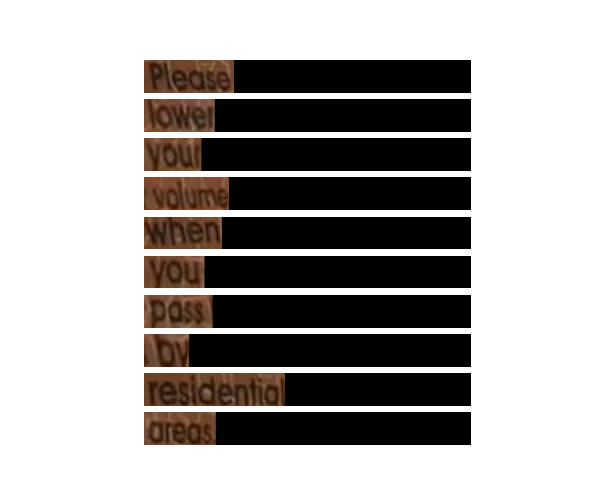
torchocr.ops.crop_quads() warps every quad into an axis-aligned strip of fixed height with
one batched grid_sample call, undoing rotation and perspective.
rec_weights = CRNN_ResNet34_VD_Weights.MJSYNTH_ICDAR2015_TOTALTEXT_MLT19
preset = rec_weights.transforms()
crops, widths = crop_quads(preset.normalize(image)[None].float(), quads, torch.zeros(len(quads), dtype=torch.long),
                           height=32, max_width=320)
print(crops.shape)  # (K, 3, 32, W)

raw, _ = crop_quads(image[None].float(), quads, torch.zeros(len(quads), dtype=torch.long), height=32, max_width=320)
fig, axes = plt.subplots(len(raw), 1, figsize=(6, 0.5 * len(raw)))
for ax, crop in zip(axes, raw):
    ax.imshow(crop.permute(1, 2, 0).clamp(0, 255).byte())
    ax.set_axis_off()
torch.Size([10, 3, 32, 320])
4. Recognition and decoding#
The recognizer emits per-column character logits for CTC. The weights entry declares its decoder: beam search with a character language model. Greedy decoding is the cheap baseline.
recognizer = CRNN(weights=rec_weights).eval()
with torch.inference_mode():
    logits = recognizer(crops)  # (T, K, num_classes)
charset = load_charset(rec_weights.meta["charset"], rec_weights.meta["num_classes"])
greedy = CTCGreedyDecoder(charset)(logits)
beam = build_decoder(rec_weights, charset)(logits)  # what the pipeline uses
for g, b in zip(greedy, beam):
    print(f"{g:>14}  {b:>14}" + ("   <- the language model changed this word" if g != b else ""))
     Please          Please
      lower           lower
       your            your
     volume          volume
       when            when
        you             you
       pass            pass
         by              by
residential     residential
      creas           creas
Total running time of the script: (0 minutes 2.829 seconds)